My friend Peter and I went out to a local Indian restaurant about a week ago to have dinner before he left for home-leave in Australia. After a wonderful meal, we called the waiter over to inquire about desert options. We were politely informed that they were serving two deserts. When we didn’t recognize either by its name, we asked the waiter to describe them. The explanation came exactly as follows:
“The first is custard mouse. The second is mouse-custard.”
I worked hard to stifle a sudden burst of laughter. I was convinced that I must have misheard the waiter and so I apologetically for the explanation again. The waiter’s face was earnest as he again politely informed me that the, “The first is custard mouse. The second is mouse custard.”
Still thoroughly confused and finding it near impossible to not roar with laughter, I asked, “What’s the difference?”
The waiter managed to look only slightly peeved and explained a third time, “The first is custard mouse. The second is mouse custard.”
Realizing that we were clearly not getting anywhere with this conversation, Peter and I thought it best to consult the menu. We noted three options listed with their traditional Indian names and asked the waiter which desert was which. Pointing to the first item, the waiter said, “This one here is the custard mouse.” Finally feeling as though we were making some progress, I asked which item the mouse custard was. Again, the waiter pointed to the first item.
I stole a brief glance at Peter, who at this stage had given up all efforts to control his laughter. We looked to the waiter and ordered one of each, figuring that this way we would at least assuage our curiosity. When the desert arrived it was indeed two different items, each of them absolutely delicious.
Ask me to describe them and what can I say? One was a custard mouse. The other was a mouse custard.
(On a fun side note, when I returned to the same restaurant two nights ago with a different friend I was asked if I would like to order a cappuccino, which I gladly accepted. The waiter returned a few minutes later and informed me that since they were very sorry, but since they had no ice cream, they could not serve me a cappuccino.)
Thursday, March 09, 2006


Crying over spilt ... eggs
Driving through Kabul’s dusty roads a week ago, I watched a swarm of people buzz by. The fabric of blue burkas billowed lightly as women walked by, some balancing overflowing trays on the curve of their heads. Old, rickety wooden carts lined the streets, their oranges, carrots and onions providing much-needed splashes of color amidst the clouds of dust rolling out from under the wheels of passing cars. Three young boys, no more than ten, passed in front of our car, their backs bent under sacks twice their size, full of red plastic watering cans. The smallest turned and wagged his finger, scolding my driver for having driven so fast and come so close. I chuckled, suddenly seeing the disapproving expression of an old man somehow transplanted under the dirty skin of this young boy’s face.
My eyes wondered down the street, inspecting the goods being sold in open store fronts. Here were all the mechanics’ stores. Empty blue, red and green gas containers hung above the entry ways. A man sat bent over an old engine, his hands and arms dyed charcoal by the oil. Outside the neighboring store, another man perched the sole of one foot against a machine and strained unsuccessfully to start it by pulling on a long cord. Two stores down yet another mechanic bent over the bonnet of a car, twisting, turning and tweaking the car’s innards unconvincingly.
A little further down the road, the blue-black of mechanic’s stores turned to the red of butchers. Large cuts of meat hung in lines. Whole fat-tailed sheep, skinned and ready for consumption hung upside-down, their fatty bottoms drooping in unappetizing wrinkles.
Between the store fronts a small alley curved round, lined on either side with the mud-brick walls of homes that stacked themselves one on top of the next up the side of a mountain. Lines of clothes crisscrossed between houses, flapping out colorful brushstrokes upon this canvas of grey. The small portrait of a woman zigzagged up an invisible path, following the mountain’s craggily surface to her home.
The world outside was filled with the busyness of life in all its wonderful contradictions. I thought to myself again how much I wanted to leave this mobile metal box and walk out into the craziness and action. Too often I feel like I am watching this country on some semi-interactive live television, displayed through the screen of my car window. Security means that I do not walk, but drive, between locations and that much of my life is lived behind the compound walls of my office and home.
Much as I have repeatedly read and heard Afghanistan’s devastating statistics, I find my heart has not yet grasped the humanity behind the numbers. I am not broken by the injustice as I think I should be. I do not really understand what it means that 1/5 of all children born die before the age of five, half of those before they reach their first birthday. I do not comprehend the full significance of the fact that the maternal mortality rate is among the three highest worldwide, parts of Afghanistan giving mothers a one in seven chance of dying from a maternal death. My brain can’t seem to grasp the consequences of the average life expectancy being 45, putting me beyond my mid-life. And the numbers go on … Perhaps they are too big and what I need is just one woman or child, one story, to give these figures a face.
The closest to discovering this face behind the numbers came a few days ago while driving home from work and watching the craze of action and life rush by my car window. Struggling against a cold that had kept me under the weather for about a month, I sat dazed and hazy, cursing the traffic and generally feeling sorry for myself at the back of my driver’s car. As I stared out mistily into the bustle that surrounded me, my eyes landed and focused on the hunched figure of a small boy, crouched with the arch of his back leant against a dirty cement wall. His arms lay crossed over his tucked-in knees. His little head was buried into the crook of his elbows – crying. Between the fan of legs that passed between him and me, I spotted the source of this little boy’s tears, the tragedy that had just taken place. By the boy’s side was an empty cardboard egg carton. Strewn in front of him were the broken white shells from which crept the yellow-white contents of his daily wages.
It is strange that in a country with such staggeringly bad statistics it would be a small boy with a few broken eggs that would bring me close to tears. I pictured the boy arriving home with no money and no eggs to face his family. Would they be angry? Did he have a father to punish him or had his father been killed during the years of conflict? Would they have money to eat that night or would he go hungry? The questions filled my head and I nearly jumped from the car, wanting to do something – to buy his broken eggs, to stop the tears, to make it better. And then suddenly, the traffic parted and my car lurched forward between two cars and around the corner. I craned my head to watch the curved figure of the boy disappear and knew that I had encountered some of the humanity behind the numbers.
My eyes wondered down the street, inspecting the goods being sold in open store fronts. Here were all the mechanics’ stores. Empty blue, red and green gas containers hung above the entry ways. A man sat bent over an old engine, his hands and arms dyed charcoal by the oil. Outside the neighboring store, another man perched the sole of one foot against a machine and strained unsuccessfully to start it by pulling on a long cord. Two stores down yet another mechanic bent over the bonnet of a car, twisting, turning and tweaking the car’s innards unconvincingly.
A little further down the road, the blue-black of mechanic’s stores turned to the red of butchers. Large cuts of meat hung in lines. Whole fat-tailed sheep, skinned and ready for consumption hung upside-down, their fatty bottoms drooping in unappetizing wrinkles.
Between the store fronts a small alley curved round, lined on either side with the mud-brick walls of homes that stacked themselves one on top of the next up the side of a mountain. Lines of clothes crisscrossed between houses, flapping out colorful brushstrokes upon this canvas of grey. The small portrait of a woman zigzagged up an invisible path, following the mountain’s craggily surface to her home.
The world outside was filled with the busyness of life in all its wonderful contradictions. I thought to myself again how much I wanted to leave this mobile metal box and walk out into the craziness and action. Too often I feel like I am watching this country on some semi-interactive live television, displayed through the screen of my car window. Security means that I do not walk, but drive, between locations and that much of my life is lived behind the compound walls of my office and home.
Much as I have repeatedly read and heard Afghanistan’s devastating statistics, I find my heart has not yet grasped the humanity behind the numbers. I am not broken by the injustice as I think I should be. I do not really understand what it means that 1/5 of all children born die before the age of five, half of those before they reach their first birthday. I do not comprehend the full significance of the fact that the maternal mortality rate is among the three highest worldwide, parts of Afghanistan giving mothers a one in seven chance of dying from a maternal death. My brain can’t seem to grasp the consequences of the average life expectancy being 45, putting me beyond my mid-life. And the numbers go on … Perhaps they are too big and what I need is just one woman or child, one story, to give these figures a face.
The closest to discovering this face behind the numbers came a few days ago while driving home from work and watching the craze of action and life rush by my car window. Struggling against a cold that had kept me under the weather for about a month, I sat dazed and hazy, cursing the traffic and generally feeling sorry for myself at the back of my driver’s car. As I stared out mistily into the bustle that surrounded me, my eyes landed and focused on the hunched figure of a small boy, crouched with the arch of his back leant against a dirty cement wall. His arms lay crossed over his tucked-in knees. His little head was buried into the crook of his elbows – crying. Between the fan of legs that passed between him and me, I spotted the source of this little boy’s tears, the tragedy that had just taken place. By the boy’s side was an empty cardboard egg carton. Strewn in front of him were the broken white shells from which crept the yellow-white contents of his daily wages.
It is strange that in a country with such staggeringly bad statistics it would be a small boy with a few broken eggs that would bring me close to tears. I pictured the boy arriving home with no money and no eggs to face his family. Would they be angry? Did he have a father to punish him or had his father been killed during the years of conflict? Would they have money to eat that night or would he go hungry? The questions filled my head and I nearly jumped from the car, wanting to do something – to buy his broken eggs, to stop the tears, to make it better. And then suddenly, the traffic parted and my car lurched forward between two cars and around the corner. I craned my head to watch the curved figure of the boy disappear and knew that I had encountered some of the humanity behind the numbers.
Tuesday, January 17, 2006
Lying on the Beach in Kabul
Exercise is a great challenge here as security greatly constricts the amount of free movement anyone can get. Before leaving Boston, I heard from my father about a yoga class that a few of his colleagues attend each week. Not ever really having taken yoga before, but figuring it could constitute yet another part of this grand new adventure, I made a point of investigating soon after my arrival and discovered there was a class on Monday evening.
The amusements started a third of the way through the class when the electricity suddenly began having what I can only describe as a sort of manic-depressive episode of on-off-on-off again flickers, finally leaving us in utter darkness. I was already beginning to suspect that the instructor was out to bend my body into positions it was never meant to take on. The lights going out only meant that I was left to bend in response to auditory commands with no visuals to follow at all. It was like a strange game of Twister without the help of knowing where the red dot is.
The instructor’s commands made the class all the more entertaining. She would say things like, “Now imagine yourself getting bigger. You’re taking up more room.” And so I would try to imagine myself taking up more room, only to realize that the whole point of taking these classes was so that I might lose some weight and take up less room.
When it came time for our relaxation exercises at the end of the class, I almost couldn’t contain the giggles. Despite my strategic position next to the stove, the classroom had been freezing all night. In preparation to unwind, the instructor told us to put on all the warm things we had. I fumbled around in the dark and managed to locate my socks, sweater, coat and shawl, which I duly wrapped tightly around me. I lay on my back, closed my eyes and prepared to become totally relaxed.
The instructor’s instructions came, “Relax your neck, your shoulders, your legs.” I tried to ease the tension and avoid the urge to shiver.
“Now imagine that you’re lying on a beach in the sun. You can feel the warmth of the sun on your face.” Struggling to keep my toes from becoming stiff with cold, all I could think was, “Lady, my imagination just cannot work that hard!”
“Now, breathe in deeply.” I inhaled deeply and almost chocked from a lung-full of diesel fumes coming from the stove. This yoga thing just cannot be good for you!
Finally, if the class hadn’t provided reason enough to laugh, through the silence I heard the soft rhythm of a man snoring. I thought, “Perhaps he found the beach.”
The amusements started a third of the way through the class when the electricity suddenly began having what I can only describe as a sort of manic-depressive episode of on-off-on-off again flickers, finally leaving us in utter darkness. I was already beginning to suspect that the instructor was out to bend my body into positions it was never meant to take on. The lights going out only meant that I was left to bend in response to auditory commands with no visuals to follow at all. It was like a strange game of Twister without the help of knowing where the red dot is.
The instructor’s commands made the class all the more entertaining. She would say things like, “Now imagine yourself getting bigger. You’re taking up more room.” And so I would try to imagine myself taking up more room, only to realize that the whole point of taking these classes was so that I might lose some weight and take up less room.
When it came time for our relaxation exercises at the end of the class, I almost couldn’t contain the giggles. Despite my strategic position next to the stove, the classroom had been freezing all night. In preparation to unwind, the instructor told us to put on all the warm things we had. I fumbled around in the dark and managed to locate my socks, sweater, coat and shawl, which I duly wrapped tightly around me. I lay on my back, closed my eyes and prepared to become totally relaxed.
The instructor’s instructions came, “Relax your neck, your shoulders, your legs.” I tried to ease the tension and avoid the urge to shiver.
“Now imagine that you’re lying on a beach in the sun. You can feel the warmth of the sun on your face.” Struggling to keep my toes from becoming stiff with cold, all I could think was, “Lady, my imagination just cannot work that hard!”
“Now, breathe in deeply.” I inhaled deeply and almost chocked from a lung-full of diesel fumes coming from the stove. This yoga thing just cannot be good for you!
Finally, if the class hadn’t provided reason enough to laugh, through the silence I heard the soft rhythm of a man snoring. I thought, “Perhaps he found the beach.”
Explosions in Kabul
I should immediately apologize for this title as it really is unfair, but I just couldn’t think of a better one. These are not the kind of explosions that one might expect here, at least not if you’re new to the country.
On Sunday afternoon, as the snow began falling heavily all over Kabul, the heater in my bedroom stopped functioning. Dad and I tried hard to rectify the situation that evening, but to no avail. I threw on an extra blanket, filled my hot-water bottle and pulled on fleece socks, determined not to let a cold Afghan night get the better of me so early in my time here.
I spent the next day working out of Dad’s room, which was considerably warmer. When a guard, who my mother nicknamed Pedro after a good Spanish friend to whom he bears a striking resemblance, came in to fill the diesel tank on Dad’s heater. Trying desperately, and unsuccessfully, to remember the word “bokhari” (heater), I tried to indicate to him that my stove had gone out and would not start. I quickly resorted to silly “come” hand gestures and got him to follow me into my bedroom.
“Oh, stop!” said Pedro upon seeing my heater.
“Yes, stop!” I replied, making more funny gestures, this time of shivering. (Now we’re communicating!)
I left him to mess with the heater and returned to the heat of my father’s room. A few minutes later Pedro entered the room again. “Miss, Stop!” I gave him a puzzled look and followed him to my bedroom. A miracle had occurred! Somehow he had managed to get the thing started again.
“You got it started!” I said with real glee.
“Yes. Start!” he said with a smile.
So where’s the explosion you ask? Well, just wait …
I returned to my father’s room to finish some emails and leave my room to heat up, when I had a sudden, strange urge to check on the stove. I got up and walked across the hall to my room. Just as I opened the door, I heard a great “WHOOOSH!” sound as the flames went shooting out. The flames then retracted momentarily before another great orange WHOOSH.
Only knowing about three Dari words so far and none of them amounting to anything approaching a frantic, “HELP, THE HOUSE IS ABOUT TO BURN DOWN!!!” I resorted to calling down a very dignified, British, “Excuse me?” The son of someone who works in the house and happens to know a little English emerged from the kitchen and seemed to become quickly confused by this strange foreign woman, looking very frightened and saying, “Come! Please, something’s happening!”
As he walked into my mini-combustion center he let out a startled “Oh!” and ran over to the stove, turning some knob and making the flames come down to a restful flicker. He turned to me, still looking rather shocked, and said, “Actually, very dangerous!” All I could do was let out a nervous laugh and repeat over and over again the word, “Tashakur” (thank you).
I’m sure this isn’t quite the kind of danger we were all anticipating, but I can now say I’ve experienced one explosion here in Kabul.
On Sunday afternoon, as the snow began falling heavily all over Kabul, the heater in my bedroom stopped functioning. Dad and I tried hard to rectify the situation that evening, but to no avail. I threw on an extra blanket, filled my hot-water bottle and pulled on fleece socks, determined not to let a cold Afghan night get the better of me so early in my time here.
I spent the next day working out of Dad’s room, which was considerably warmer. When a guard, who my mother nicknamed Pedro after a good Spanish friend to whom he bears a striking resemblance, came in to fill the diesel tank on Dad’s heater. Trying desperately, and unsuccessfully, to remember the word “bokhari” (heater), I tried to indicate to him that my stove had gone out and would not start. I quickly resorted to silly “come” hand gestures and got him to follow me into my bedroom.
“Oh, stop!” said Pedro upon seeing my heater.
“Yes, stop!” I replied, making more funny gestures, this time of shivering. (Now we’re communicating!)
I left him to mess with the heater and returned to the heat of my father’s room. A few minutes later Pedro entered the room again. “Miss, Stop!” I gave him a puzzled look and followed him to my bedroom. A miracle had occurred! Somehow he had managed to get the thing started again.
“You got it started!” I said with real glee.
“Yes. Start!” he said with a smile.
So where’s the explosion you ask? Well, just wait …
I returned to my father’s room to finish some emails and leave my room to heat up, when I had a sudden, strange urge to check on the stove. I got up and walked across the hall to my room. Just as I opened the door, I heard a great “WHOOOSH!” sound as the flames went shooting out. The flames then retracted momentarily before another great orange WHOOSH.
Only knowing about three Dari words so far and none of them amounting to anything approaching a frantic, “HELP, THE HOUSE IS ABOUT TO BURN DOWN!!!” I resorted to calling down a very dignified, British, “Excuse me?” The son of someone who works in the house and happens to know a little English emerged from the kitchen and seemed to become quickly confused by this strange foreign woman, looking very frightened and saying, “Come! Please, something’s happening!”
As he walked into my mini-combustion center he let out a startled “Oh!” and ran over to the stove, turning some knob and making the flames come down to a restful flicker. He turned to me, still looking rather shocked, and said, “Actually, very dangerous!” All I could do was let out a nervous laugh and repeat over and over again the word, “Tashakur” (thank you).
I’m sure this isn’t quite the kind of danger we were all anticipating, but I can now say I’ve experienced one explosion here in Kabul.
Shades of Grey - Arriving in Kabul
Just as the women who walk behind the thin mesh veil of their burqas, Kabul seems shrouded beneath a gauzy grey blanket of dust. The grey sheathe masks the cities’ subtle beauties and graceful dignity so that one needs to look just a little closer, behind the curtain, to the eyes of this wonderful country. Indeed, it is in the faces of Afghans that I suspect the color really lies.
Dad and I arrived in Kabul last Thursday evening on a UN flight from Dubai. The fiercely jagged peaks of the Hindu Kush rose and jutted to either side of the plane, their snow-covered edges making their appearance all the more awe-inspiring. This is the kind of beauty we are not meant to understand nor to contain, but to respect and tremble at. It was here, in some unforgiving crevice of the mountains, that my parents’ organization lost three young women in a plane crash just one year ago. As we approached Kabul, I watched this new world approach through the small portal window next to me. The plane suddenly dipped, coming into the city’s valley, and then circled uncomfortably close to the surrounding mountains before landing on a small runway.
My father and I gathered our belongings and I brought my shawl over my head to cover my hair, tossing a loose end over my left shoulder. Backpack on, we went through passport control, which roughly consisted of two small desks ceremoniously placed behind Plexiglas walls. We collected our luggage from an equally cramped and dusty room and discovered the driver waiting for us outside.
My first views of the city were clouded by a thick fog of jet-lag made worse by a sleepless night in Dubai. Others in the car politely pointed out various landmarks as I struggled to make my mind process anything. Pot-holed streets bumped up against one another, flanked on either side by cement and mud-brick walls that guarded Kabul’s more private life. Driving here feels like a constant off-roading adventure, made more interesting by the myriad obstacles of people, bicycles and deep sewage ditches someone here has nicknamed “alligator pits”. It is the ultimate testosterone tussle – cars and drivers involved in a constant alpha-male gorilla battle to claim space and establish dominance.
We finally arrived at the house unscathed and were greeted by Dad’s guards, who wore some of the largest smiles I have ever seen as they shook his hand, embraced him and welcomed him home. Expecting them to politely greet me with “Salaam”, I was surprised when they shook my hand as well and then, looking to my father, said “dokhtar” (daughter). I shall never forget those smiles.
Yes, I think I will enjoy it here. The security and subsequent constraints on movement around the city will be a challenge and frustration, I’m sure. But I sense this city and this country hold something far more beautiful than the image captured in our Western media spots. In fact, I begin to wonder if it isn’t those images that have created the real veil behind which Afghanistan remains hidden to much of the world.
“You are welcome here. I hope that your time in Kabul will be good.” This is the regular greeting I have received from Afghans. Today, an Afghan doctor followed this statement with, “Many people have fear to come here. I hope you will like it.”
Yes, many people do have fear to come here, and perhaps some of you are fearful having me here. Things do happen – bombs go off, people are killed and kidnapped – these are a reality. But they are only one part of the reality and do not reflect the Kabul – the Afghanistan – I am slowly meeting and I hope to show you all in the coming months.
Dad and I arrived in Kabul last Thursday evening on a UN flight from Dubai. The fiercely jagged peaks of the Hindu Kush rose and jutted to either side of the plane, their snow-covered edges making their appearance all the more awe-inspiring. This is the kind of beauty we are not meant to understand nor to contain, but to respect and tremble at. It was here, in some unforgiving crevice of the mountains, that my parents’ organization lost three young women in a plane crash just one year ago. As we approached Kabul, I watched this new world approach through the small portal window next to me. The plane suddenly dipped, coming into the city’s valley, and then circled uncomfortably close to the surrounding mountains before landing on a small runway.
My father and I gathered our belongings and I brought my shawl over my head to cover my hair, tossing a loose end over my left shoulder. Backpack on, we went through passport control, which roughly consisted of two small desks ceremoniously placed behind Plexiglas walls. We collected our luggage from an equally cramped and dusty room and discovered the driver waiting for us outside.
My first views of the city were clouded by a thick fog of jet-lag made worse by a sleepless night in Dubai. Others in the car politely pointed out various landmarks as I struggled to make my mind process anything. Pot-holed streets bumped up against one another, flanked on either side by cement and mud-brick walls that guarded Kabul’s more private life. Driving here feels like a constant off-roading adventure, made more interesting by the myriad obstacles of people, bicycles and deep sewage ditches someone here has nicknamed “alligator pits”. It is the ultimate testosterone tussle – cars and drivers involved in a constant alpha-male gorilla battle to claim space and establish dominance.
We finally arrived at the house unscathed and were greeted by Dad’s guards, who wore some of the largest smiles I have ever seen as they shook his hand, embraced him and welcomed him home. Expecting them to politely greet me with “Salaam”, I was surprised when they shook my hand as well and then, looking to my father, said “dokhtar” (daughter). I shall never forget those smiles.
Yes, I think I will enjoy it here. The security and subsequent constraints on movement around the city will be a challenge and frustration, I’m sure. But I sense this city and this country hold something far more beautiful than the image captured in our Western media spots. In fact, I begin to wonder if it isn’t those images that have created the real veil behind which Afghanistan remains hidden to much of the world.
“You are welcome here. I hope that your time in Kabul will be good.” This is the regular greeting I have received from Afghans. Today, an Afghan doctor followed this statement with, “Many people have fear to come here. I hope you will like it.”
Yes, many people do have fear to come here, and perhaps some of you are fearful having me here. Things do happen – bombs go off, people are killed and kidnapped – these are a reality. But they are only one part of the reality and do not reflect the Kabul – the Afghanistan – I am slowly meeting and I hope to show you all in the coming months.
Wednesday, January 04, 2006
Preparations
How does one begin preparing for two years in Afghanistan?
Preparing for the actual travel is one thing. I find myself seated cross-legged on my bathroom floor, surrounded by a world in miniature – Little bottles of shampoo; little bars of soap; funny little foot scrubbers. I begin to wonder whether someone will also have shrunk my destination (Little Kabul?).
Kabul doesn’t feel little at the moment. Nor does this move. The floor and bed of my sister’s bedroom, covered with what will become the contents of my father and my suitcases, attests to the bigness of this move. Apparently two years in Afghanistan roughly translates to six toothbrushes, twelve boxes of tampons, two blow-dryers, five chap-stick tubes and tons of hair things. I find all this utterly absurd and rather overwhelming.
Six and a half years ago, I found myself in a similar state, this time cross-legged on my parents’ living room floor. Piled high around me were empty boxes and suitcases, and stacks of clothes and sheets and stuff that were meant to have been neatly packed into them. I looked, half-crying, at my mother. “I’m not ready,” I said. To this day, neither she nor I are sure whether I was referring to lack of progress I had made in filling boxes or whether, instead, I was saying something deeper and more significant. “I’m not ready … for college, for leaving, for life.”
Of course, I was ready and off we drove, car packed full of all my freshman belongings. By the time we arrived, something had changed and I settled in quickly. My words to my mother were my only real hint at this vague fear I held that I was not at all prepared for the next stage of my life.
Today, I am tempted again to say, “I’m not ready.” The truth is that I’m not sure what exactly to be ready for. Afghanistan feels like an amorphous fog with promises of adventure, growth and challenge just beyond the next wisp of white cloud. Through the veil, I think I begin to see the snow-covered, dusty roads packed full of cars and trucks maneuvering themselves around one another. I think I get a glimpse of men and women wrapped tightly with dark grey-brown shawls. For an instant, I even wonder if I smell or hear something of this new and foreign place. But then, just as soon as these visions begin to crystallize – poof, a wind blows in and everything vanishes again behind a new blanket of cloud.
On Monday, I will load up a car with suitcases and bags. I will look around this house in which I have lived since I was twelve, but which my parents plan to sell for an impending move to Spain. I will step on a plane, kick off my shoes under the seat in front of me and buckle my seatbelt. I will vaguely hear the stewardess recite the safety procedures I have heard hundreds of times. And then we will begin to taxi off and I will watch this country begin to move, slowly at first with a low grumble and then quicker, whirring higher. And I will say goodbye to this country as my home for the last time. When the buildings beneath me have almost vanished, I will look away from the window, close my eyes, thank God for wonderful years here and this time, I will say, “I am ready.”
Preparing for the actual travel is one thing. I find myself seated cross-legged on my bathroom floor, surrounded by a world in miniature – Little bottles of shampoo; little bars of soap; funny little foot scrubbers. I begin to wonder whether someone will also have shrunk my destination (Little Kabul?).
Kabul doesn’t feel little at the moment. Nor does this move. The floor and bed of my sister’s bedroom, covered with what will become the contents of my father and my suitcases, attests to the bigness of this move. Apparently two years in Afghanistan roughly translates to six toothbrushes, twelve boxes of tampons, two blow-dryers, five chap-stick tubes and tons of hair things. I find all this utterly absurd and rather overwhelming.
Six and a half years ago, I found myself in a similar state, this time cross-legged on my parents’ living room floor. Piled high around me were empty boxes and suitcases, and stacks of clothes and sheets and stuff that were meant to have been neatly packed into them. I looked, half-crying, at my mother. “I’m not ready,” I said. To this day, neither she nor I are sure whether I was referring to lack of progress I had made in filling boxes or whether, instead, I was saying something deeper and more significant. “I’m not ready … for college, for leaving, for life.”
Of course, I was ready and off we drove, car packed full of all my freshman belongings. By the time we arrived, something had changed and I settled in quickly. My words to my mother were my only real hint at this vague fear I held that I was not at all prepared for the next stage of my life.
Today, I am tempted again to say, “I’m not ready.” The truth is that I’m not sure what exactly to be ready for. Afghanistan feels like an amorphous fog with promises of adventure, growth and challenge just beyond the next wisp of white cloud. Through the veil, I think I begin to see the snow-covered, dusty roads packed full of cars and trucks maneuvering themselves around one another. I think I get a glimpse of men and women wrapped tightly with dark grey-brown shawls. For an instant, I even wonder if I smell or hear something of this new and foreign place. But then, just as soon as these visions begin to crystallize – poof, a wind blows in and everything vanishes again behind a new blanket of cloud.
On Monday, I will load up a car with suitcases and bags. I will look around this house in which I have lived since I was twelve, but which my parents plan to sell for an impending move to Spain. I will step on a plane, kick off my shoes under the seat in front of me and buckle my seatbelt. I will vaguely hear the stewardess recite the safety procedures I have heard hundreds of times. And then we will begin to taxi off and I will watch this country begin to move, slowly at first with a low grumble and then quicker, whirring higher. And I will say goodbye to this country as my home for the last time. When the buildings beneath me have almost vanished, I will look away from the window, close my eyes, thank God for wonderful years here and this time, I will say, “I am ready.”
Sunday, December 04, 2005
Beef Stew and Chocolate-dipped Faith
I walked into a Christian bookstore a few days ago in search of a devotional - a workbook to help me daily study God's word. I've been slacking recently and my relationship with God has suffered from the neglect. I was hoping to find something to really help me dig in and wrestle with hard questions and issues - I was craving spiritual meat.
What I found was a Christianity that seemed to have been hijacked by mass commercialism, witty one-liners and feel-good, self-help nonsense. Rather than a store full of resources for strengthening a Christian's faith, encouraging their souls and challenging them to walk more closely with God, the store resembled Oprah's book club, selling wimpy truths and pats on the back.
The women's section was by far the worst! Apparently Christian books aimed at women have discarded the belief that we are powerful, thinking, believing, praying, conquering creations of a mighty God. Instead, the faith represented on the women's bookshelf gave the impression that all we really needed were nice, happy thoughts each day accompanied by a tasty recipe. "Jesus loves you ... here's a nice recipe for beef stew." Am I the only one that feels the issues of my life and this world require more substance than that provided by a recipe book pretending to be a devotional???
Do you know there is actually a book called, Faith-dipped Chocolate for women? It "offers readers who crave chocolate delicious encouragement for their faith. Sprinkled throughout are yummy recipes, fun chocolate facts, ideas for creating chocolate gifts, and quotes celebrating God's gifts of chocolate." One reviewer actually said, "Served up with rich morsels of Scripture, Faith-Dipped Chocolate gives a little taste of heaven on earth." Now ladies, love for chocolate aside, COME ON!!! Can you really imagine Paul finishing every chapter of Romans with creative recipe ideas for manna and quail?
I grieve the fact that somehow we have corporately bought into this mundane version of faith. How is beef stew or "chocolate-dipped faith" going to help me walk with God? Is beef stew going to help me battle the sins that constantly entangle me - my pride, my fear, etc.? Is it going to help me love this world radically? Please someone, tell me where is the substance of our faith? Where is the power?
Is no one else dissatisfied by this cheap knock-off? Like the Louis Vuitton and Prada fakes sold on city street corners, have we really settled for something that may vaguely represent the real thing but will quickly fall apart the second anything heavy is put inside it?
Perhaps that is the problem. Perhaps we all have sold out and given up the desire to search for and find truth. Perhaps we have stopped believing that there is a truth to be found. Lets face it, while our generation affirms people's right to believe, we do not believe in the substance, the ultimate truth and reality of what they believe in. As a result, all we're left with are nice, happy thoughts, but little substance and no power.
I truly hope that we are not so easily satisfied. I know for myself that I crave more depth. I desire to love God with all my heart, to see Him work in and through me, to see the world changed for the better. I want to see the Church stand up against injustice and be known for being outstanding in our love and brave in the way that we face the difficulties of this world. I alone am powerless to do any of these things and will never be satisfied by a faith that thinks beef stew and chocolate are all the nourishment that I need.
What I found was a Christianity that seemed to have been hijacked by mass commercialism, witty one-liners and feel-good, self-help nonsense. Rather than a store full of resources for strengthening a Christian's faith, encouraging their souls and challenging them to walk more closely with God, the store resembled Oprah's book club, selling wimpy truths and pats on the back.
The women's section was by far the worst! Apparently Christian books aimed at women have discarded the belief that we are powerful, thinking, believing, praying, conquering creations of a mighty God. Instead, the faith represented on the women's bookshelf gave the impression that all we really needed were nice, happy thoughts each day accompanied by a tasty recipe. "Jesus loves you ... here's a nice recipe for beef stew." Am I the only one that feels the issues of my life and this world require more substance than that provided by a recipe book pretending to be a devotional???
Do you know there is actually a book called, Faith-dipped Chocolate for women? It "offers readers who crave chocolate delicious encouragement for their faith. Sprinkled throughout are yummy recipes, fun chocolate facts, ideas for creating chocolate gifts, and quotes celebrating God's gifts of chocolate." One reviewer actually said, "Served up with rich morsels of Scripture, Faith-Dipped Chocolate gives a little taste of heaven on earth." Now ladies, love for chocolate aside, COME ON!!! Can you really imagine Paul finishing every chapter of Romans with creative recipe ideas for manna and quail?
I grieve the fact that somehow we have corporately bought into this mundane version of faith. How is beef stew or "chocolate-dipped faith" going to help me walk with God? Is beef stew going to help me battle the sins that constantly entangle me - my pride, my fear, etc.? Is it going to help me love this world radically? Please someone, tell me where is the substance of our faith? Where is the power?
Is no one else dissatisfied by this cheap knock-off? Like the Louis Vuitton and Prada fakes sold on city street corners, have we really settled for something that may vaguely represent the real thing but will quickly fall apart the second anything heavy is put inside it?
Perhaps that is the problem. Perhaps we all have sold out and given up the desire to search for and find truth. Perhaps we have stopped believing that there is a truth to be found. Lets face it, while our generation affirms people's right to believe, we do not believe in the substance, the ultimate truth and reality of what they believe in. As a result, all we're left with are nice, happy thoughts, but little substance and no power.
I truly hope that we are not so easily satisfied. I know for myself that I crave more depth. I desire to love God with all my heart, to see Him work in and through me, to see the world changed for the better. I want to see the Church stand up against injustice and be known for being outstanding in our love and brave in the way that we face the difficulties of this world. I alone am powerless to do any of these things and will never be satisfied by a faith that thinks beef stew and chocolate are all the nourishment that I need.
Sunday, November 20, 2005
Sunrise in México, Sunset in DC
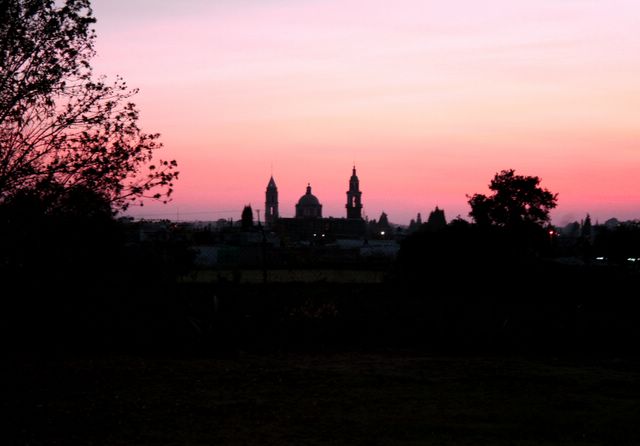 The drive through the mountains from Cuernavaca to Mexico City is magnificent. Sharp green covered cliffs stand erect on one side of the highway. Small pueblos of grey cement block buildings are nuzzled into the mountain’s crevasses. Laundry flaps lazily in the wind as a man works the corn in his garden. With the setting sun, the silhouettes of distant mountains turn varying shades of blue and purple against pink and orange clouds. Fields of hay stacks glisten a warm gold. The valley slowly fills with a great sea of lights, splashing like waves against the sides of hills, turned islands.
Early this morning, this valley I have come to love bid me farewell. Through blurry, tired eyes, I watched the sun rise and the sky come awake in pinks and blues. After several hours of flying, lost luggage and missed flights, I looked out the shuttle window at Washington Dullus Airport to see the same sun setting behind lines of planes.
It is thoroughly strange to think that five wonderful weeks in México have come to an end. There is so much that changes with only a few hours in a plane. The air here in Boston is different – colder and crisper. It feels fresher, though not as comfortable as the warmth of Cuernavaca.
I feel grateful that I know these places so well – that I can navigate the streets and speak the languages, that I have come to know and understand some of the rhythm of each place. I am grateful that as I drive through Boston I feel a love for this city as well as a readiness to leave it and move to the next place. I am grateful that far away there are other cities and other countries that I will come to know and love like these. I am grateful that this is my life – a life lived here amidst the wonder of so much of God’s creation.
Wednesday, November 02, 2005
And I'm going to ...
Afghanistan.
That's right friends - I will be traveling to Kabul in January. For the first few months I will live with my father and will be taking Dari language lessons. (That's right ... from one language school to another. It's rather a shame they don't speak Spanish in Afghanistan.) I will spend the first few months volunteering with Future Generations, the same organization out of which I will be doing my Masters program. In March, I will travel to India for a month to meet with my fellow students and learn on site there. When I return to Kabul in April, the hope is that I will take over from a young man who has been working with Future Generations for the past couple of years. At about that time, my father will be finishing his time in Afghanistan so I will move to another house.
I am both terribly excited and rather overwhelmed. The thought, "Oh dear, what have I just gotten myself into" has definitely crossed my mind. Having said all this, I am also struck that the Lord, again, has provided overwhelmingly. Praise God!
I am both terribly excited and rather overwhelmed. The thought, "Oh dear, what have I just gotten myself into" has definitely crossed my mind. Having said all this, I am also struck that the Lord, again, has provided overwhelmingly. Praise God!
Friday, October 28, 2005
Romance
From a darkened room I write – the blue haze of my computer screen stroking my face. With the power out, it provides the only light, save a candle that sits by my bedside. Outside, the rain in pouring down, a rare thing for Cuernavaca, la Eterna Primavera (Eternal Spring). My body feels full with contentment, having just returned from the most magnificent dinner.
...........................................
Flickering honey-colored lights quiver and skip across white linen table cloths, moving and swaying to the rhythm of a fountain’s falling water. A pink orchid hangs overhead from its earthen basket. A stairwell, painted warm yellow and orange, rises upwards and around the plaza in which I am seated – wine in hand, letting the tastes of fresh goat cheese and apple slices encircle my mouth. And then, softly at first, the music begins. The sound creeps upwards, rising into a crescendo, the notes beginning to swell within my chest. Just as my body feels full with the light, the music, the romance and the beauty, he steps forward and stands at my side. Like releasing the power and beauty of a great ocean wave, he opens his mouth and out swells the most glorious voice – to serenade me.
Never before have I experienced the shear force and power of a voice so close that it caused me to tremble and my heart to falter. Never before has opera music sounded so serenely beautiful. Never before have I struggled so hard to find one word, even one, in Spanish or English, to express my emotion. Never before!
Never before have I experienced the shear force and power of a voice so close that it caused me to tremble and my heart to falter. Never before has opera music sounded so serenely beautiful. Never before have I struggled so hard to find one word, even one, in Spanish or English, to express my emotion. Never before!
...........................................
México is a country saturated with this magic and romance. It is a country full of the richness of love and affection.
Sitting at dinner with friends, there is the constant dance of couples’ hands twisting and turning, entwining themselves around one another. As if simultaneously carrying on two conversations, their hands whisper to one another with assurances of affection while their mouths go on speaking with others at the table.
Their words, too, betray something of México’s romantic sentimentality. The language is full with the richness of couples’ affection – “mi amor” (my love), “mi vida” (my life), “mi reina” (my queen), couples call one another.
A walk through a park is a walk through couples, their bodies curled round one another, lent against tree trunks, reclining on benches, sprawled across the grass. This is not the place for the PDA-wary. Even the car alarms here whistle as if at a beautiful woman passing by.
I enjoy the freedom of love here. I enjoy its taste. I enjoy the shamelessness of affection. And I wonder why we aren’t all so generous in our demonstrations of love, so affirming of our feelings.
Sitting at dinner with friends, there is the constant dance of couples’ hands twisting and turning, entwining themselves around one another. As if simultaneously carrying on two conversations, their hands whisper to one another with assurances of affection while their mouths go on speaking with others at the table.
Their words, too, betray something of México’s romantic sentimentality. The language is full with the richness of couples’ affection – “mi amor” (my love), “mi vida” (my life), “mi reina” (my queen), couples call one another.
A walk through a park is a walk through couples, their bodies curled round one another, lent against tree trunks, reclining on benches, sprawled across the grass. This is not the place for the PDA-wary. Even the car alarms here whistle as if at a beautiful woman passing by.
I enjoy the freedom of love here. I enjoy its taste. I enjoy the shamelessness of affection. And I wonder why we aren’t all so generous in our demonstrations of love, so affirming of our feelings.
Monday, October 24, 2005
Pyramid Stones & Life's Construction
Have you ever wondered whether you should give up on the thing that you have felt yourself made for all of your life? This is where I am tonight.
Since I can remember, working and living in developing countries alongside poor communities has been a defining part of who I am and who I hope to be. It is so much of what makes up my heart, like an undercurrent to my life.
There was a period of my life when I experimented with the idea of white picket-fences and 2.5 children. I tried to adjust my childhood normalcy to that of my American and British friends. I tried to convince myself that perhaps I could be happy and fulfilled in suburbia.
Here in Mexico, the Spanish conquistadors used the stones from pyramids they had demolished to construct churches and palaces. I have tried to do this - to take the materials of my childhood and adult experiences and construct something different, something of the "developed" world, something normal . . . But I can't. The stones in Mexico were made to come together into magnificent pyramids. The stones of my childhood were made to construct a life lived overseas. And yet, in the midst of tiredness and discouragement, I can't help but wonder at how easy it would be if only I could build something different.
I have been trying to find a field placement for the past several months and trying to hold the faith that the Lord that I love, the Lord that has provided for me so abundantly in the past will do so again. And while I believe this, I find I am sapped of energy. After months of trying to convince various NGOs of my infinite value and potential, I am becoming less convinced.
I know many would urge me to have faith in myself. I have never quite understood this. The older I get, the more of a lie it appears to be. Have faith in myself? I am not all-powerful. I cannot control the way the world moves. I am just a woman - wonderfully and carefully made with gifts and talents, yes - but still just a woman and therefore weak and limited. My life and this world are far too complicated and far too dangerous for me to place my faith in this fragility.
I wonder at how the pillars of my faith did it - kept the faith in God's overwhelming love and power despite all that happened to them and around them. The troubles of my situation are so terribly small in comparison, and yet I doubt. The Word says that "... faith is the assurance of things hoped for, the conviction of things not seen. (Heb 11:1). I am learning that it is not merely a exercise of the mind, but a work of one's will. It is labor . . . and I am tired.
So this is where I remember that while, in all my perfectionistic nature, I long to never doubt, I also belong to a God that has told me, "Cast all your burdens on me, for I care for you." After all, it is He that has been building my life such that I long to be in the field. It is He who created these stones, He who decided what they would make and He who will ultimately construct something magnificent with my life.
Since I can remember, working and living in developing countries alongside poor communities has been a defining part of who I am and who I hope to be. It is so much of what makes up my heart, like an undercurrent to my life.
There was a period of my life when I experimented with the idea of white picket-fences and 2.5 children. I tried to adjust my childhood normalcy to that of my American and British friends. I tried to convince myself that perhaps I could be happy and fulfilled in suburbia.
Here in Mexico, the Spanish conquistadors used the stones from pyramids they had demolished to construct churches and palaces. I have tried to do this - to take the materials of my childhood and adult experiences and construct something different, something of the "developed" world, something normal . . . But I can't. The stones in Mexico were made to come together into magnificent pyramids. The stones of my childhood were made to construct a life lived overseas. And yet, in the midst of tiredness and discouragement, I can't help but wonder at how easy it would be if only I could build something different.
I have been trying to find a field placement for the past several months and trying to hold the faith that the Lord that I love, the Lord that has provided for me so abundantly in the past will do so again. And while I believe this, I find I am sapped of energy. After months of trying to convince various NGOs of my infinite value and potential, I am becoming less convinced.
I know many would urge me to have faith in myself. I have never quite understood this. The older I get, the more of a lie it appears to be. Have faith in myself? I am not all-powerful. I cannot control the way the world moves. I am just a woman - wonderfully and carefully made with gifts and talents, yes - but still just a woman and therefore weak and limited. My life and this world are far too complicated and far too dangerous for me to place my faith in this fragility.
I wonder at how the pillars of my faith did it - kept the faith in God's overwhelming love and power despite all that happened to them and around them. The troubles of my situation are so terribly small in comparison, and yet I doubt. The Word says that "... faith is the assurance of things hoped for, the conviction of things not seen. (Heb 11:1). I am learning that it is not merely a exercise of the mind, but a work of one's will. It is labor . . . and I am tired.
So this is where I remember that while, in all my perfectionistic nature, I long to never doubt, I also belong to a God that has told me, "Cast all your burdens on me, for I care for you." After all, it is He that has been building my life such that I long to be in the field. It is He who created these stones, He who decided what they would make and He who will ultimately construct something magnificent with my life.
Thursday, October 13, 2005
First Nights
It is a strange feeling to be in a country for the first night. The air seems to move under a different weight, as if adopting its own peculiar walk. In Mexico, that air walks in circles around me with a heavy fullness. The spaces between people are filled with it. It is as if the air becomes the meeting ground for noises and smells and all that combines to make a place. The air has a feeling to it.
I arrived in Mexico this evening, exhausted. After waking up at 4:30AM to catch my flight, I spent the second half of the trip from Chicago to Mexico sitting next to a woman and her three year old daughter - adorable, but lacking in any understanding of good ol' American personal space. I kept scolding myself after picturing the scene from Dirty Dancing - "This is my dance space. This is your dance space." Oh, I should know better than to be this possessive over air.
From Mexico City, I traveled about an hour and a half to Cuernavaca. The trip south begins in the mass traffic jam that is the center of D.F. (Destrito Federal). Street markets, business people, tourists, buses, taxis, bicycles all collide in a wonderful crash of color and sound. Slowely this wonderful commotion begins to subside into city neighborhoods with houses rather than buildings. Cement walls surround the more expensive homes but do not keep out the gentle roar of the city that is like an undertow that keeps these suburbs tied to the city. And then, finally, the roar of the city dies and is replaced the silent music of the mountains. Jagged rocks rise on either side, lined with fluorescent green moss and grass. Then suddenly a valley breaks and there, nestled in the richness of the green are the familiar corrugated tin roofs of little pueblos. A man's horse plods slowely forward while a child runs quickly buy.
Do we know how fortunate we are? Do we realize the richness of cities and pueblos?
I know that it is on these evenings, having arrived again in a new and familiar place that the fullness of the air and the life that it holds suddenly feel more precious. It is on these first nights, before I am used to all that surrounds me that I realize how overwhelmingly full of life and beauty this world is! And then I think, I want to be a part of this world. I want to live here. And then I realize that it is precisely because it is new that I am struck be it, and that this life does surround us, wherever in the world we find ourselves.
I arrived in Mexico this evening, exhausted. After waking up at 4:30AM to catch my flight, I spent the second half of the trip from Chicago to Mexico sitting next to a woman and her three year old daughter - adorable, but lacking in any understanding of good ol' American personal space. I kept scolding myself after picturing the scene from Dirty Dancing - "This is my dance space. This is your dance space." Oh, I should know better than to be this possessive over air.
From Mexico City, I traveled about an hour and a half to Cuernavaca. The trip south begins in the mass traffic jam that is the center of D.F. (Destrito Federal). Street markets, business people, tourists, buses, taxis, bicycles all collide in a wonderful crash of color and sound. Slowely this wonderful commotion begins to subside into city neighborhoods with houses rather than buildings. Cement walls surround the more expensive homes but do not keep out the gentle roar of the city that is like an undertow that keeps these suburbs tied to the city. And then, finally, the roar of the city dies and is replaced the silent music of the mountains. Jagged rocks rise on either side, lined with fluorescent green moss and grass. Then suddenly a valley breaks and there, nestled in the richness of the green are the familiar corrugated tin roofs of little pueblos. A man's horse plods slowely forward while a child runs quickly buy.
Do we know how fortunate we are? Do we realize the richness of cities and pueblos?
I know that it is on these evenings, having arrived again in a new and familiar place that the fullness of the air and the life that it holds suddenly feel more precious. It is on these first nights, before I am used to all that surrounds me that I realize how overwhelmingly full of life and beauty this world is! And then I think, I want to be a part of this world. I want to live here. And then I realize that it is precisely because it is new that I am struck be it, and that this life does surround us, wherever in the world we find ourselves.
Monday, October 10, 2005
For those in the know - by common demand
I received so many questions as to what it is that I am doing that I am finally deciding to post to add to the confusion.
I left Washington, DC and returned to Boston in mid-September when my father returned from Afghanistan and my sister from Scotland. My family spend a wonderful couple of weeks together.
On October 13, I leave for Mexico for five weeks to continue my Spanish language study and visit with some friends of the family. As some of you may recall, these are the same people that I stayed with for a month in the summer of 2004.
On November 20, I return to Boston from Mexico only to turn right around on November 21 and head California where I will spend Thanksgiving with a couple of my best friends.
When I return from California on November 29, I will continue my search for scholarships, fellowships, etc. In January of 2005 I will begin a blended learning Masters in Applied Community Change and Conservation program with Future Generations. I will be based in the field (though this is a rather large detail yet to be worked out) and will apply all the lessons back into the context of the communities with whom I work. Once a semester, my fellow students will gather together from more than a dozen countries to study in a different field site. In March '05, I will be in India, August '05 in New York, March '06 in Peru and August '06 I will be graduating in Tibet.
I hope this has managed to eliminate some of the confusion, though somehow I have my doubts. Let me know if you think you get it - I could use some of that clarity.
I left Washington, DC and returned to Boston in mid-September when my father returned from Afghanistan and my sister from Scotland. My family spend a wonderful couple of weeks together.
On October 13, I leave for Mexico for five weeks to continue my Spanish language study and visit with some friends of the family. As some of you may recall, these are the same people that I stayed with for a month in the summer of 2004.
On November 20, I return to Boston from Mexico only to turn right around on November 21 and head California where I will spend Thanksgiving with a couple of my best friends.
When I return from California on November 29, I will continue my search for scholarships, fellowships, etc. In January of 2005 I will begin a blended learning Masters in Applied Community Change and Conservation program with Future Generations. I will be based in the field (though this is a rather large detail yet to be worked out) and will apply all the lessons back into the context of the communities with whom I work. Once a semester, my fellow students will gather together from more than a dozen countries to study in a different field site. In March '05, I will be in India, August '05 in New York, March '06 in Peru and August '06 I will be graduating in Tibet.
I hope this has managed to eliminate some of the confusion, though somehow I have my doubts. Let me know if you think you get it - I could use some of that clarity.
Thursday, September 15, 2005
Perfectly and Abundantly Providing
 We serve an abundantly and perfectly providing God! I am reminded of this particularly today as I prepare for my last day in Washington, DC, a city that has held both my great joy and great pain. It seems strange that it is the loss of goodbyes and all the incredible uncertainty that lies before me that now reminds me of God’s character and the confidence I can find within it.
I have said so many goodbyes in the past week and have felt rather overrun with weariness. The most painful came last Sunday, when I bid my church family farewell. This fellowship of believers have formed my community and my home for the past three years and have taught me what true koinonia, or fellowship of brothers and sisters, is meant to look like. They have taught me, too, just how messy ministry is, how costly justice is, how powerful truth is and how crucial love is. There simply are not words for what this family of believers means to me.
In addition to my church, I have said goodbye to friends from various parts of my life – GWU, World Vision, Little Lights Urban Ministries. Just last night, I was blindfolded and taken for a picnic at National Airport by three dear friends at work. A few nights ago I shared dinner with old housemates from Little Lights’ Ministry House. The goodbyes have been taxing, particularly as I do not yet know what I am saying hello to.
Even in this series of goodbyes and the presence of such uncertainty, however, the Lord has reminded me of His perfect love and provision. The goodbyes have become markers not so much of loss, but of what all God has provided for me in these last six years. The very sting of loss has signaled the great joy that these friendships have brought me, and so in the midst of all the uncertainty and sadness I have been reminded that God will continue to do as He has so consistently in my life – provide.
So today, as I leave this city, these friendships and this body of believers that I love, I have a choice – to be discouraged by the uncertainty of next steps or encouraged by the certainty of God’s character and the remembrance of His consistent provision. Today is when my choice of faith is made.
(To see photographs of those I have said goodbye to, visit www.wokabaut.shutterfly.com)
Tuesday, August 30, 2005
Welcome to the Journey
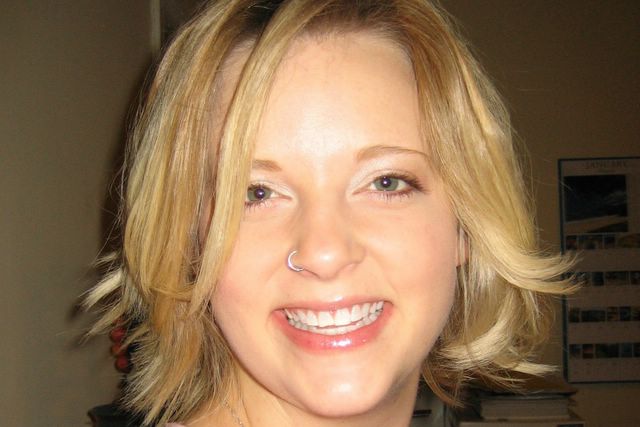 “Where are you from?” This is both the most telling and the most difficult question for me to answer. My practiced response comes in one long breath: “My father is from Scotland and my mother is from Finland. I was born in London, but I grew up in Sierra Leone and Papua New Guinea.” This, my simplest and quickest response, usually evokes a series of blank stares and confused mutterings from listeners who had anticipated a simple and brief exchange of polite small talk.
 A more complete and far more complicated answer to this question reveals that I am at once from everywhere and from nowhere. Though I am able to make a home in most any country or community, I rarely find myself completely at home anywhere. Instead, my identity lies somewhere in the meeting of cultures and peoples. I am one of a strange and growing breed of TCKs or Third Culture Kids, raised between cultures.
Home, for me, cannot be defined with easy geographic boundaries. Instead, I discover it in the swirl of images and smells and feelings and sounds that make up my memory. It is in the white caked-on clay covering an Asaro mudman’s skin. It is in the smell of burnt wood that clings to an Ethiopian cross. It is in the sweet, wet coolness that encircles the green of a rice paddy after monsoon rain. It is in the beat and rhythm of foreign tongues singing foreign songs late into the night out of open storefronts.
Two summers ago, in the middle of a city I had never before visited, I came home in the most powerful way. I had come to work with Sudanese refugees in Egypt’s bustling capital, Cairo, and was invited to a wedding by my fellow teachers. Standing outside a Christian church in a Muslim country, my pale Scandinavian arms stood in stark contrast to the elaborate henna designs that decorated them. I wore the freshly tie-dyed African outfit for which I had been fitted days earlier. As I walked through the doors, Dinka, Nuer and Azande friends met me with handshakes and embraces. They smiled with their broad grins and remarked together, “Now you are a proper African!” Laughing with them, I moved slowly inside and found my place about halfway down one aisle. The beat of a drum began and I raised my voice with those around me to sing in a language I could not understand. Just as the chorus reached its peak, a woman two rows behind me released her high-pitched, joyful and triumphant Azande ululation. The tears began to fall down my cheeks, as suddenly I recognized this place. I looked at a friend and said, “I’m home”.
Today, I realize that I am saying goodbye to one home while moving forward toward another. In the postings that will follow, I invite you to join me in this exploration of home, culture, faith and life. I have named the blog, "Wokabaut Bilong Mi", Pidgin English meaning "My Journey" precisely because the title's language nods to my past in Papua New Guinea and its message looks forward expectantly to all that the future holds. Perhaps as you walk with me, you too will discover a world of new homes. Welcome to the journey!
Thursday, July 15, 2004
Güerita and Chapulines
Hello again from beautiful Mexico:
I love that sounds, smells and tastes in every country hold meanings that we each interpret differently. Last week I ate chapulines (grasshoppers), a delicacy to some in Mexico. But I am willing to bet that my sister and several other friends are reading this thinking, "OH MY GOODNESS ... GROSS!" (Actually, they weren´t bad. I don´t, however, have any deep inclinations towards making them a regular part of my diet.)
Sounds too mean different things to each of us. On Sunday morning in Querétero I woke up to the sound of fireworks (minus the fire part) being set off in celebration of San Antonio´s day. In between the loud bangs, the bells of about three or four different churches in the area seemed to quarrel with one another over which melody to play. I swear I thought that the city had suddenly come under attack and that the churches were ringing out for the men of the town to gather up their pitchforks and take to the streets in defense of their women and children.
Other than minor heart attacks I have suffered from fiesta celebrations of the past couple of weeks, I have been enjoying myself thoroughly. Rainy-season has begun so the days are considerably cooler and we often get tremendous thunder and lightening storms in the late afternoon/early evening. I have continued my adventures around Mexico with my host family.
Two weekends ago we spent Saturday at their alternative house and I thoroughly roasted myself in the sun (ouch!!) because I was an idiot and didn´t put on sun-screen. On Sunday, we went to Xochicalco, one of the most important archeological sites in Mexico. Just over ten years ago, all that was known of the grand city that prospered between the years of 700-900 A.D. was one pyramid. As archaeologists began searching the surrounding area they discovered that a huge city of pyramids, houses and temples lay hidden beneath what had appeared to be a mountain top. Today, you can walk around these beautiful and utterly impressive ruins. It makes you look at mountains in a different way, wondering all the time what secrets lay hidden beneath their surface.
Carved into the side of a mountain in Xochicalco is a man-made cave. Deep inside there is a hole in the ´ceiling´. One time each year, on summer solstice, the sun is in exactly the right place to shine through that hole, forming a perfect hexagon on the floor of the cave. The people that lived during the time of Xochicalco had a religious calendar of 52 years. Incredibly, 52 days before and 52 days after the hexagon, part of the sun shines through the hole. As luck would have it, we were there during one of those days. We were told that if you put water under the light you can see the stars and the moon reflected. Also, if you put your arm under the light at just the right distance from the ground, the light acts like an X-ray and you can see your bones. How it is that over one thousand years ago they created this in a whole without light is beyond me.
This past weekend, we drove about three or four hours north to see two lovely colonial towns particularly important for their roles in the Mexican independence movement, Querétero and San Miguel de Allende. The final soccer match was on Sunday as well as the festival for San Antonio so San Miguel de Allende was in a total uproar. We had loads of fun pottering around old Mexican streets and markets, watching an utterly ridiculous parade go through town and sipping cold cervezas in beautiful plazas.
Soon, these adventures will end however as this is my final week here in Mexico. The time has flown by and I am already beginning to feel the pangs of saying goodbye to another country that is becoming dear to me. I think about Cairo a lot here. I suppose it is because last summer was a time of reconning with the various, and occasionally conflicting, paths of my life. I find myself missing DC and Peace Fellowship, knowing with certainty that that is the place to which I am called for this time in my life. At the same time, however, another part of my heart whispers to me what I know to be true: that everything about me is made for different cultures and countries. So the challenge becomes how to be at home in a place without being so comfortable there that I am not willing to move nor too impatient for another place that I cannot make roots.
I am beginning to feel that in the duality of not being able to call just one place home and at the same time being able to make a home almost anywhere, my strange upbringing has gifted me. I can imagine myself here in Mexico, or in Cairo, or in Sudan, or Afghanistan, or Washington, DC ... if that is where God has sent me. Slowly I am beginning to understand what the Bible means when it says that I am a pilgrim, a stranger and an alien, in this world. I am beginning to find hope in the reality that my belonging and my home, something that has been allusive for much of my life, is rooted not in a country or passport, but in the home that waits for me in heaven. So here in Mexico I am "Güerita" (i.e. blondie) and much as I may hope I cannot fade into the Mexican background. But maybe that can serve to remind me of another reality that is always present.
Next weekend I will go up to Mexico City for Saturday and Sunday and I fly home to Boston on Monday. Tuesday, Mom and I will fly to Spain where I will continue my Spanish-learning, only this time with a listhp. I will meet up with Annina later in the summer in Scotland and she will join us for one week in Finland (I am so excited!). Dad left last Thursday for Scotland and England where he is visiting family and taking a few days of vacation time before he flies to Afghanistan. From what I hear he is doing well and I am really looking forward to hearing his reports from Afghanistan. I would appreciate your prayers as he travels and we all get used to the change.
I feel so fortunate to have this opportunity to travel and relax. I miss you all very much and love getting emails from you. I will likely have less access to the Internet for the next few weeks but I will see what I can do to keep up with emails. Please do keep them coming.
Love and blessings to you all,
Katrina
PS - One more funny from Mexico: When visiting the United States several years ago, the father of one of my mexican friends went to a Catholic Church. Throughout the service the priest and several others kept speaking about a Mr. Cabody. Assuming that this man was very important, he asked someone after the service who Mr. Cabody was. The man responded, "No, no. Not Mr. Cabody ... Mystical Body". Today, that is his nickname. Also amusing from his trip were his attempts to translate his Spanish directly into english. When asking people to enter a room he said, "Between, between" (a translation of entre, entre in Spanish). When asking someone to take a seat he said, "Drink a seat" (a translation of the verb tomar which both means to take and to drink). Hope you all enjoy!
Wednesday, June 02, 2004
Silver and Gold: The Streets and Churches of Mexico
Dear all,
It seems utterly odd to think that I have now been in Mexico for almost two weeks. This week has been significantly more frustrating on the Spanish end as I struggle to communicate with those around me. Happily, everyone here is really encouraging and patient (for which I am utterly grateful).
This past Friday, after classes, I ate a quick lunch at my house and then journeyed back to my school for salsa dancing lessons. What fun! While I'm fairly convinced that I will never have the hips or attitude of local Mexicans, a gringa can always try. Saturday I went with my Mexican family to their other house in a small pueblo about thirty minutes away. The house and surrounding land is absolutely gorgeous, and I had a lovely time swimming and stuffing myself with delicious quesadillas. YUM!!! Then, on Sunday, my Mexican mother, sister and I went for a day excursion to Taxco, the silver capital of Mexico. MUY PELIGROSO (very dangerous)! Taxco is a beautiful historic town on the 'falda' (literally 'skirt' or side) of a mountain. White houses with red tile roofs and black lettering line narrow, twisting roads. Balconies cascade with flowers. The plaza is filled with people selling everything imaginable, including fried potatoes with hot sauce. On one side of the plaza is the sixteenth century church built by the Borda family, founders of the town. Every wall inside the church is covered with ornate gold sculptures and paintings. I could go on and on to describe the smells and tastes. We took breaks in a local cafe and restaurant where we sat on balconies overlooking the town. It was an absolutely magical day.
I am increasingly interested by the role of religion here in Mexico. The vast majority of people here are Catholic, a result of the Spanish influence. For some it is a truly real and powerful faith. For many others, it is an integral part of their culture that informs traditions but does not substantially challenge the status quo or induce significant change in people's lives. The devision between Catholics and 'Christians' is deeply felt here as many see the Catholic church as loosing members to more recent and more modern protestant movements.
Also interesting are the conflicting sentiments regarding the Catholic Church's influence in the colonization of Mexico and the abuse of indigenous groups here. Everywhere, one can see the mixing of indigenous beliefs and practices with the Catholic faith. Paintings on Cathedral walls have skulls and particular flowers important to the indigenous. During the colonial age when many indigenous people were forced to join the church, they often hid statues of their gods under the altar or inside a crucifix. They pretended to pray to to the Catholic God, all the while directing their prayers to their god hidden inside.
I find all of this both thoroughly interesting and terribly disturbing. One of my teachers told me yesterday that she could not believe in a religion that dismissed her culture. By many here, the church (particularly the Catholic church) is seen as a political entity as much as a religious one. People recognize the influence of the Catholic church in impressing one set of cultural values (those of the Spaniards) and seeking to destroy others (those of the indigenous people). They resent the church for that.
I begin to think about the final command of Christ, 'Go therefore and make disciples of all nations, baptizing them in the name of the Father and the Son and the Holy Spirit' (Matt 28: 19). And then the words of Paul, 'There is neither Jew nor Greek, there is neither slave nor free man, there is neither male nor female for you are all one in Christ Jesus' (Gal 3:28). Why has the church so often come with the gospel in one hand and the greedy desire to conquer in the other? Was it not the example of Christ to come not as a conquering hero but as a humble carpenter? Did he not abandon his 'heavenly culture' for that of earth? How far we have strain! As I have often commented, the church and believers are different from God and faith. But I am impressed here by what an influence the church and believers can have on people's willingness to know the God or embrace the faith.
I feel burdened here that the Church (both Catholic and Protestant) must repent for the ways it has distorted the good news of a humble servant God who did not come seeking earthly gain, but gave all that we might live. Heavy on my heart are the questions of how to have relevant ministries that embrace and celebrate the diversity of cultures in this world with humility.
I do love it here. Every day is a mini-adventure of new discoveries. Happily I have managed to avoid more adventures with birds or rutas (though I did wait for a routa that went to the centro for 40 minutes yesterday ... it's not like the centro is out of the way or unpopular so I'm not sure why it took so long). I love hearing from you all so please do continue to write when you can. A quick update and thanks to you all: my grandmother seems to have recovered nicely for which I am very grateful.
Big hugs to you all,
- Katrina
PS - More funnies: A few days ago when trying to remember the word for head (cabeza), I called my head cerveza (beer) evoking great laughs all around. A friend at the school when trying to say 'pecado mortal' (a mortal sin) said instead 'pescado mortal' (mortal fish). Hope you enjoy these little foibles.
It seems utterly odd to think that I have now been in Mexico for almost two weeks. This week has been significantly more frustrating on the Spanish end as I struggle to communicate with those around me. Happily, everyone here is really encouraging and patient (for which I am utterly grateful).
This past Friday, after classes, I ate a quick lunch at my house and then journeyed back to my school for salsa dancing lessons. What fun! While I'm fairly convinced that I will never have the hips or attitude of local Mexicans, a gringa can always try. Saturday I went with my Mexican family to their other house in a small pueblo about thirty minutes away. The house and surrounding land is absolutely gorgeous, and I had a lovely time swimming and stuffing myself with delicious quesadillas. YUM!!! Then, on Sunday, my Mexican mother, sister and I went for a day excursion to Taxco, the silver capital of Mexico. MUY PELIGROSO (very dangerous)! Taxco is a beautiful historic town on the 'falda' (literally 'skirt' or side) of a mountain. White houses with red tile roofs and black lettering line narrow, twisting roads. Balconies cascade with flowers. The plaza is filled with people selling everything imaginable, including fried potatoes with hot sauce. On one side of the plaza is the sixteenth century church built by the Borda family, founders of the town. Every wall inside the church is covered with ornate gold sculptures and paintings. I could go on and on to describe the smells and tastes. We took breaks in a local cafe and restaurant where we sat on balconies overlooking the town. It was an absolutely magical day.
I am increasingly interested by the role of religion here in Mexico. The vast majority of people here are Catholic, a result of the Spanish influence. For some it is a truly real and powerful faith. For many others, it is an integral part of their culture that informs traditions but does not substantially challenge the status quo or induce significant change in people's lives. The devision between Catholics and 'Christians' is deeply felt here as many see the Catholic church as loosing members to more recent and more modern protestant movements.
Also interesting are the conflicting sentiments regarding the Catholic Church's influence in the colonization of Mexico and the abuse of indigenous groups here. Everywhere, one can see the mixing of indigenous beliefs and practices with the Catholic faith. Paintings on Cathedral walls have skulls and particular flowers important to the indigenous. During the colonial age when many indigenous people were forced to join the church, they often hid statues of their gods under the altar or inside a crucifix. They pretended to pray to to the Catholic God, all the while directing their prayers to their god hidden inside.
I find all of this both thoroughly interesting and terribly disturbing. One of my teachers told me yesterday that she could not believe in a religion that dismissed her culture. By many here, the church (particularly the Catholic church) is seen as a political entity as much as a religious one. People recognize the influence of the Catholic church in impressing one set of cultural values (those of the Spaniards) and seeking to destroy others (those of the indigenous people). They resent the church for that.
I begin to think about the final command of Christ, 'Go therefore and make disciples of all nations, baptizing them in the name of the Father and the Son and the Holy Spirit' (Matt 28: 19). And then the words of Paul, 'There is neither Jew nor Greek, there is neither slave nor free man, there is neither male nor female for you are all one in Christ Jesus' (Gal 3:28). Why has the church so often come with the gospel in one hand and the greedy desire to conquer in the other? Was it not the example of Christ to come not as a conquering hero but as a humble carpenter? Did he not abandon his 'heavenly culture' for that of earth? How far we have strain! As I have often commented, the church and believers are different from God and faith. But I am impressed here by what an influence the church and believers can have on people's willingness to know the God or embrace the faith.
I feel burdened here that the Church (both Catholic and Protestant) must repent for the ways it has distorted the good news of a humble servant God who did not come seeking earthly gain, but gave all that we might live. Heavy on my heart are the questions of how to have relevant ministries that embrace and celebrate the diversity of cultures in this world with humility.
I do love it here. Every day is a mini-adventure of new discoveries. Happily I have managed to avoid more adventures with birds or rutas (though I did wait for a routa that went to the centro for 40 minutes yesterday ... it's not like the centro is out of the way or unpopular so I'm not sure why it took so long). I love hearing from you all so please do continue to write when you can. A quick update and thanks to you all: my grandmother seems to have recovered nicely for which I am very grateful.
Big hugs to you all,
- Katrina
PS - More funnies: A few days ago when trying to remember the word for head (cabeza), I called my head cerveza (beer) evoking great laughs all around. A friend at the school when trying to say 'pecado mortal' (a mortal sin) said instead 'pescado mortal' (mortal fish). Hope you enjoy these little foibles.
Wednesday, May 26, 2004
Mi segunda leccion de Mexico
Buenas tardes mis amigos,
Well, it seems there are several people with the same questions: Why are you in Mexico? My mother's probably having a fit laughing right now because she says that I often begin speaking with the assumption that everyone else has been in my head and knows what I've been thinking or doing. So let me fill in the gaps. I am in Mexico for one month living with friends of my family and doing an immersion Spanish language program. Basically, it's speak, think, hear, be in spanish ... sink or swim ... fabulous and exhausting! The town that I am in, Cuernavaca, is about an hour and a half south of Mexico City. It's beautiful! There's a 16th century cathedral about two blocks from my house that I walk by several times a day and loads of buganvillias (flowers that are these brilliant hues of pink and purple and orange). I love it. After this month in Mexico my mom and I are going to travel around Spain for about three weeks and then visit family in Europe.
Happily I have avoided any more encounters with the birds in Cuernavaca, though every Mexican that I have told the story has laughed and said, "Si, es muy commun" ... "Yes, it's very common." Has no one thought to buy some bee-bee guns and take care of this little problem?
I had my second major lesson from Mexico today on the way to and from school: Do not trust the rutas (little buses that travel around the city). Every day, my school begins at 9AM with coffee and discussion for about ten minutes and then classes. The school itself is located in a different section of the city west of the center where I live so I need to take some kind of transportation to and from the school. I have two options: 1) take a taxi which costs about twenty pesos (approximately 2 US dollars) or 2) take a ruta which costs 3.50 in pesos (approximately 35 US cents). While taxis are certainly not expensive ... the more money I save on transportation, the more I have to spend on gifts so it is clearly to all our benefit for me to take the ruta. This all would be well and good if the rutas made any sense whatsoever! But they don't.
This morning, I had the adventure of trying to work out exactly where I was supposed to find the ruta going in the direction of my school. I asked several people, and either they did not know or my Spanish is not very good, because it took me a LONG time to find a ruta. When I did finally see a Ruta 6 (the number that I need) I flagged it down and got on. About thirty minutes later I was fairly convinced that we were going in the absolute OPPOSITE direction from my school so I got off the ruta. At this point I was already about twenty minutes late for school and had absolutely no clue where I was. I flagged down a taxi and it took us another thirty minutes or so to get to my school. On the up side, I had a lovely conversation with the taxi driver in Spanish.
Well, after many laughs over just how far away from the school I had gotten, I went through my various classes and then began my journey home. Now, "Surely," you say, "Katrina would never make the same mistake twice!" Oh, but I would ... two more times. I got on the ruta and twenty minutes later began to have the same strange lurking feeling that "we're not in Kansas anymore, Todo". So I asked the woman in front of me and she kindly told me that I needed to be going in the opposite direction. Good! I got off, had more adventures finding a stop in the opposite direction, waited for twenty minutes for a bus, and got on (this time after having checked that the sign in the window read "Al Centro"). Finally I was on the right ruta ... only this time I missed the centro stop because it was a part of the center of town that I did not recognize. Needless to say, I took a taxi home. As it turns out, the ruta 6 goes in four different directions. Why they don't just give thes e rutas different numbers, I have no idea. I blame my trouble both on the bad markings of the rutas and a head injury I incurred in the morning when I walked full speed ahead into a glass door I thought was open.
Well, other than the unfortunate adventures with rutas, I really am enjoying myself. I've done my fair bit of sightseeing and this weekend will do more. My spanish classes are really helpful and I'm learning an enormous amount. It's very tiring, but exciting as well when I'm able to have a conversation in spanish with a random person on the street. I feel utterly spoilt to have this opportunity. It's great fun!
Well, it seems there are several people with the same questions: Why are you in Mexico? My mother's probably having a fit laughing right now because she says that I often begin speaking with the assumption that everyone else has been in my head and knows what I've been thinking or doing. So let me fill in the gaps. I am in Mexico for one month living with friends of my family and doing an immersion Spanish language program. Basically, it's speak, think, hear, be in spanish ... sink or swim ... fabulous and exhausting! The town that I am in, Cuernavaca, is about an hour and a half south of Mexico City. It's beautiful! There's a 16th century cathedral about two blocks from my house that I walk by several times a day and loads of buganvillias (flowers that are these brilliant hues of pink and purple and orange). I love it. After this month in Mexico my mom and I are going to travel around Spain for about three weeks and then visit family in Europe.
Happily I have avoided any more encounters with the birds in Cuernavaca, though every Mexican that I have told the story has laughed and said, "Si, es muy commun" ... "Yes, it's very common." Has no one thought to buy some bee-bee guns and take care of this little problem?
I had my second major lesson from Mexico today on the way to and from school: Do not trust the rutas (little buses that travel around the city). Every day, my school begins at 9AM with coffee and discussion for about ten minutes and then classes. The school itself is located in a different section of the city west of the center where I live so I need to take some kind of transportation to and from the school. I have two options: 1) take a taxi which costs about twenty pesos (approximately 2 US dollars) or 2) take a ruta which costs 3.50 in pesos (approximately 35 US cents). While taxis are certainly not expensive ... the more money I save on transportation, the more I have to spend on gifts so it is clearly to all our benefit for me to take the ruta. This all would be well and good if the rutas made any sense whatsoever! But they don't.
This morning, I had the adventure of trying to work out exactly where I was supposed to find the ruta going in the direction of my school. I asked several people, and either they did not know or my Spanish is not very good, because it took me a LONG time to find a ruta. When I did finally see a Ruta 6 (the number that I need) I flagged it down and got on. About thirty minutes later I was fairly convinced that we were going in the absolute OPPOSITE direction from my school so I got off the ruta. At this point I was already about twenty minutes late for school and had absolutely no clue where I was. I flagged down a taxi and it took us another thirty minutes or so to get to my school. On the up side, I had a lovely conversation with the taxi driver in Spanish.
Well, after many laughs over just how far away from the school I had gotten, I went through my various classes and then began my journey home. Now, "Surely," you say, "Katrina would never make the same mistake twice!" Oh, but I would ... two more times. I got on the ruta and twenty minutes later began to have the same strange lurking feeling that "we're not in Kansas anymore, Todo". So I asked the woman in front of me and she kindly told me that I needed to be going in the opposite direction. Good! I got off, had more adventures finding a stop in the opposite direction, waited for twenty minutes for a bus, and got on (this time after having checked that the sign in the window read "Al Centro"). Finally I was on the right ruta ... only this time I missed the centro stop because it was a part of the center of town that I did not recognize. Needless to say, I took a taxi home. As it turns out, the ruta 6 goes in four different directions. Why they don't just give thes e rutas different numbers, I have no idea. I blame my trouble both on the bad markings of the rutas and a head injury I incurred in the morning when I walked full speed ahead into a glass door I thought was open.
Well, other than the unfortunate adventures with rutas, I really am enjoying myself. I've done my fair bit of sightseeing and this weekend will do more. My spanish classes are really helpful and I'm learning an enormous amount. It's very tiring, but exciting as well when I'm able to have a conversation in spanish with a random person on the street. I feel utterly spoilt to have this opportunity. It's great fun!
I do enjoy getting emails from you all and I will do my best to keep responding. Please forgive me if they are generally short or tardy. If you would, please keep my grandmother and the rest of my family in your prayers. Two days ago she fell and cut her forearms and yesterday morning about 11AM was unresponsive when someone came to check in on her. She's doing much better now, but it gave us all a bit of a fright. We're not sure if it was a minor stroke or something else. I am thankful to God that she knows the Lord because she has so much peace with the time of life that she is in and the eventuality of death. For her it is a going home to be with her Lord. What a wonderful thought!
Okay, that's all for now. I do love you all and pray that your summers are fruitful and restful.
PS: One brief story on the importance of NOT assuming that you can turn all english words into spanish ones with a different pronunciation. I recently learned that preservatives in spanish are not "preservativos". One of the students in my school asked his Mexican mother if there were preservativos in his food only to discover that preservativos are condoms. Mexican cooking is different, but not that different. He also learned that if he said he was embarazada (which he thought might mean embarrased), he was telling people that he was pregnant. Ooops.
Saturday, May 22, 2004
Buenas Días de México
Buenos días!
Well, I arrived safely in Mexico City on Thursday afternoon, excited and nervous all at the same time. The airport is your basic international airport, except, of course, every sign is in Spanish. It´s amazing how much your eyes can take in at one time, all the colors and sights. I managed to locate a little store where I could buy a Latadel phone card and the bus station to Cuernavaca. The bus ride to Cuernavaca made me a little sick with all the twists and turns in the road and the changes in altitude (Cuernavaca is higher than Mexico City), but the views were magnificent.
Perhaps the most amusing this thus far has been the way that my English is deteriorating. When someone asks me what we call a certain thing in English, I find it incredibly difficult to remember. Clearly my brain is not gifted with working on so many different levels. In Chicago (my stop over city) my french was challenged as well when I met a guy from Madrid. Do you know what it´s like to try to speak to someone in three different languages ... my head hurt.
Cuernavaca is a really lovely little city about an hour and a half south of Mexico City. It is the vacation spot for many people from Mexico City and is called ¨Eternal Spring¨. The weather is absolutely beautiful and thus far the people have been very friendly. The birds however, are not so kind. Yesterday I was pooped on TWICE while sitting on a bench. My first lesson from Mexico - it is not wise to sit under branches. I do find it wonderful, however, the way that everyone and everything seem to constantly be chattering to one another. Sitting on that unfortunate bench, the birds were clammering on (I´m now convinced that they were saying something like, ¨Look out below!¨). And all around the people were doing the same thing. I love the life of this place.
My Spanish is already improving and while I still struggle along to speak, I am able to understand a fair amount. I begin my immersion classes at Encuentros on Monday so hopefully we can accellerate the pace after that.
Okay, now off to more Spanish-speaking fun.
I love you all!
Adios
Well, I arrived safely in Mexico City on Thursday afternoon, excited and nervous all at the same time. The airport is your basic international airport, except, of course, every sign is in Spanish. It´s amazing how much your eyes can take in at one time, all the colors and sights. I managed to locate a little store where I could buy a Latadel phone card and the bus station to Cuernavaca. The bus ride to Cuernavaca made me a little sick with all the twists and turns in the road and the changes in altitude (Cuernavaca is higher than Mexico City), but the views were magnificent.
Perhaps the most amusing this thus far has been the way that my English is deteriorating. When someone asks me what we call a certain thing in English, I find it incredibly difficult to remember. Clearly my brain is not gifted with working on so many different levels. In Chicago (my stop over city) my french was challenged as well when I met a guy from Madrid. Do you know what it´s like to try to speak to someone in three different languages ... my head hurt.
Cuernavaca is a really lovely little city about an hour and a half south of Mexico City. It is the vacation spot for many people from Mexico City and is called ¨Eternal Spring¨. The weather is absolutely beautiful and thus far the people have been very friendly. The birds however, are not so kind. Yesterday I was pooped on TWICE while sitting on a bench. My first lesson from Mexico - it is not wise to sit under branches. I do find it wonderful, however, the way that everyone and everything seem to constantly be chattering to one another. Sitting on that unfortunate bench, the birds were clammering on (I´m now convinced that they were saying something like, ¨Look out below!¨). And all around the people were doing the same thing. I love the life of this place.
My Spanish is already improving and while I still struggle along to speak, I am able to understand a fair amount. I begin my immersion classes at Encuentros on Monday so hopefully we can accellerate the pace after that.
Okay, now off to more Spanish-speaking fun.
I love you all!
Adios
Subscribe to:
Posts (Atom)
